
A three year old spends ten minutes pouring water from a jug into a row of cups. Some overflow. Some stay half empty. She tips one back, tries again and announces that this cup is "the most full". In your child's learning observations, that moment might be linked to "Outcome 4". It looks like water play. It is also a child testing ideas, persisting and using the language of measurement, and the outcome is how educators describe that learning.
If you have ever wondered what those outcomes mean, this guide walks through all five outcomes, what they look like in a real day and how to use them when you talk with your child's educators.
Why the EYLF Outcomes Matter So Much in the Early Years
Childcare services across Australia plan their programs around a national framework called Belonging, Being and Becoming: The Early Years Learning Framework, or EYLF. The current version, V2.0, was approved in 2022. It sets out principles for educators, practices for teaching and five Learning Outcomes for children from birth to five. In Victoria, services also have their own approved framework, the Victorian Early Years Learning and Development Framework, which shares the same five outcomes.
The outcomes are deliberately broad. They describe the kind of person a child is growing into, not a list of facts to memorise. That matters because young children do not learn in subjects. One game in the sandpit can build friendships, muscles, vocabulary and early maths all at once. The outcomes give educators a shared way to notice that learning, plan what comes next and explain it to families.
The name of the framework is a good summary of its thinking. Belonging is about relationships and feeling part of a family, a group and a community. Being is about childhood as a time that matters in its own right, not only as preparation for school. Becoming is about the rapid change that happens in these years.
Outcome 1: Children have a strong sense of identity. Your child feels safe, known and confident enough to try things on their own.
Outcome 2: Children are connected with and contribute to their world. They learn to belong to a group, respect differences and care for the environment.
Outcome 3: Children have a strong sense of wellbeing. This covers physical health, movement and the ability to understand and manage feelings.
Outcome 4: Children are confident and involved learners. Curiosity, persistence, problem solving and imagination all sit here.
Outcome 5: Children are effective communicators. Talking, listening, storytelling, early literacy, early numeracy, music and art.
The Five Outcomes in an Ordinary Day
At Chipmunks, programs are updated every week and built on what children are interested in right now, so the outcomes show up in ordinary moments, not special lessons. Here is what each one can look like.
Outcome 1: Identity
A toddler waves goodbye at drop-off and walks to the puzzle table on their own. A preschooler tells the group about their weekend at their grandmother's house. A baby reaches for a familiar educator. Each is a child who feels secure enough to explore. Educators build this outcome through warm, consistent relationships, by learning each family's routines and by letting children make real choices.
Outcome 2: Connection and contribution
Sorting the recycling after lunch. Watering the garden. Learning a greeting in a friend's home language. Helping a younger child find their hat. This outcome is about belonging to something bigger than yourself and discovering that what you do affects other people and the natural world.
Outcome 3: Wellbeing
Wellbeing has a physical side and an emotional side. The obstacle course, the yoga session and the climb to the top of the fort all build strength and coordination. Washing hands, serving food and resting when tired build healthy habits. A quiet conversation about feeling cross when a tower falls down builds the emotional side, and it is every bit as important.
Outcome 4: Confident and involved learning
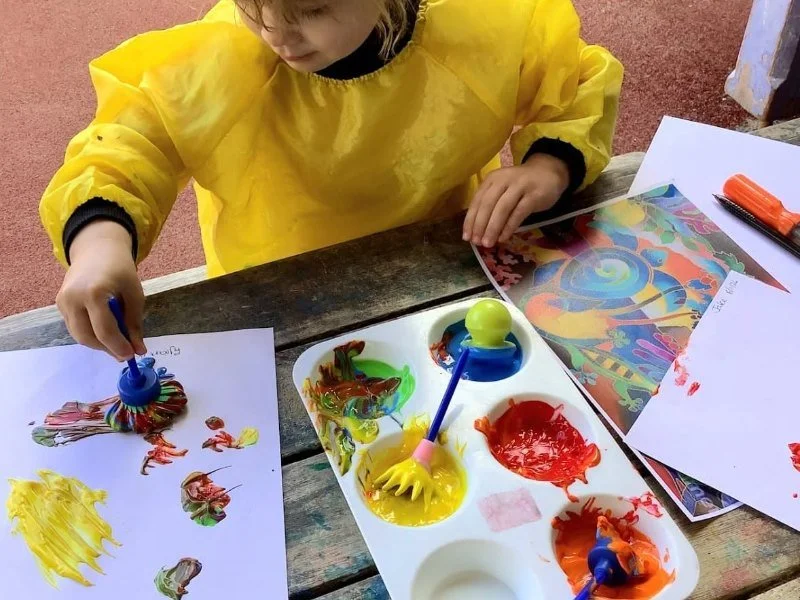
This is the child at the water trough. It is also the child who rebuilds a block bridge four times, who asks where the puddle went, who turns a cardboard box into a bus. Educators support this outcome by offering open-ended materials, asking good questions and giving children time to stay with a problem.
Outcome 5: Communication
Story time, a made-up song, a shopping list "written" in squiggles, counting the stairs, a painting with a long explanation attached. Communication in the EYLF is much wider than speech. It includes early literacy and numeracy, the arts and, increasingly, safe and sensible use of technology.
Most experiences cover several outcomes at once, which is why a single moment can show learning in more than one area.
How Educators Use the Outcomes for Your Child
The outcomes are not a test and children do not pass or fail them. The framework itself is clear that children progress in different and equally meaningful ways, and that learning is not always predictable or linear. A child may race ahead in language and take longer to feel confident in a group, or the reverse.
Educators use the outcomes as a lens within a planning cycle: they observe, think about what the observation shows, plan an experience to extend it, put it into practice and then reflect on how it went. In practice, that means monthly learning observations that capture what your child is doing and what it shows, daily reflections that give you a window into the day, and an end-of-year portfolio that brings the story together.
When you know the outcomes, those updates become far more useful. A photo of your child serving their own lunch is Outcome 3 at work: they are building independence and healthy habits, not simply eating.
Questions Worth Asking Your Child's Educators
Knowing the outcomes also gives you better questions than "How was their day?". Try one of these at pick-up or in your next conversation with the room leader:
What is my child most interested in at the moment, and how are you building on it?
Which outcome do you see them growing in most this term?
Is there something you are working on that we could back up at home?
Educators value these conversations. The EYLF treats families as a child's first and most influential teachers, and what you share about home helps shape the program.
Extending the Learning at Home
You do not need to teach the outcomes. You are almost certainly supporting them already.
Identity: offer real choices, such as which shirt to wear or which book to read first, and share family stories and photos.
Connection: give your child a small household job that helps everyone, like feeding a pet or watering a plant.
Wellbeing: name feelings out loud, yours as well as theirs, and make time to run, climb and rest.
Learning: when they ask why, ask what they think before you answer, and let them struggle a little before you step in.
Communication: talk through your day, sing in the car, count the steps and let them see you read and write.
Frequently Asked Questions
Are the EYLF outcomes a checklist my child has to complete? No. They describe broad areas of growth across the first five years. Educators use them to notice and plan for learning, not to grade children, and there is no set age by which an outcome must be reached.
How do the outcomes connect to school readiness? Closely. A child who feels secure, can manage feelings, stays curious and communicates well is ready to learn in a classroom. Literacy and numeracy grow out of Outcomes 4 and 5, and the independence schools look for grows out of Outcomes 1 and 3.
Does every childcare centre use the same outcomes? Yes. The EYLF is a nationally approved learning framework, and Victoria's own framework uses the same five outcomes, so they are the same in every approved service. How each centre brings them to life, through its people, its spaces and its program, is what differs.
Seeing the Whole Child
The five outcomes are a reminder that early learning is about the whole child: who they are, how they feel, how they think and how they connect. They also give families and educators a common language, so that the small moments of a day can be recognised for the learning they hold.
If you would like to see how a play-based program brings the outcomes to life, book a tour at your nearest Chipmunks Childcare centre and ask the educators to show you an observation.
