
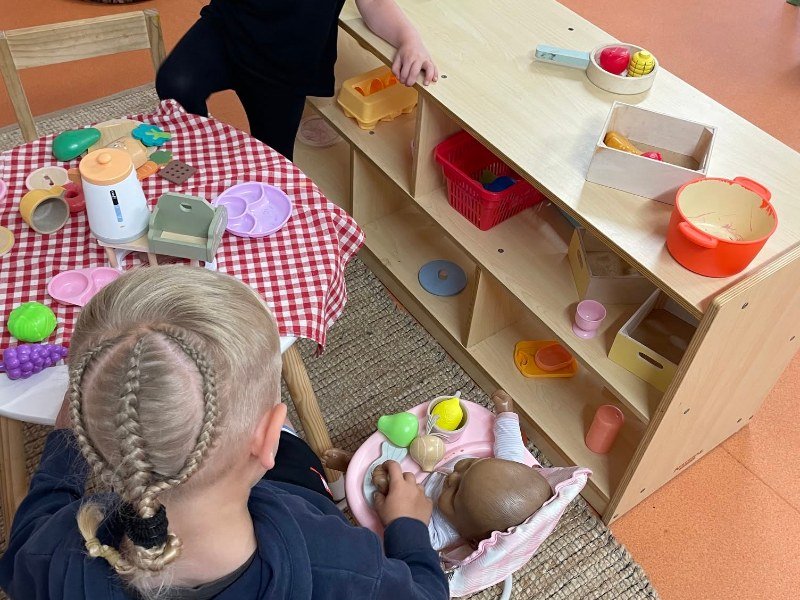
Two four year olds are running a cafe from behind an upturned crate. One writes orders in careful zigzags. The other counts out bottle-top coins and tells a customer, firmly, that the babycino machine is broken. Nobody has asked them to practise writing, counting or negotiating. They are doing all three, and they will keep it up far longer than they would at a worksheet.
That is play-based learning. It is also the reason an early learning room looks so different from a classroom, and why "What did you do today?" so often gets the answer "Played".
Why Play Matters So Much in the Early Years
Play-based learning means that play is the main way children learn, with educators planning the environment and joining in on purpose. It is the approach set out in Australia's Early Years Learning Framework, and in Victoria's own early years framework, and it is used in early learning programs around the world.
It works because of how young children are built. They learn with their whole bodies, they remember what they care about, and they will repeat something they enjoy until they have mastered it. Play supplies all three conditions at once. A child who is told that five is more than three may nod. A child who has just been given three crackers when a friend got five understands it completely.
Language: pretend play needs a running commentary, so children stretch their vocabulary and practise conversation.
Early maths: building, sorting, sharing and scoring are full of number, shape and measurement.
Self-control: games have rules, turns and roles, and sticking to them is real practice at managing impulses.
Problem solving: a tower that keeps falling teaches more about balance than any explanation.
Social skills: joining a game, sharing an idea and settling a disagreement are learnt by doing.
Confidence: in play, children are in charge, and being trusted with decisions builds belief in themselves.
The Kinds of Play You Will See
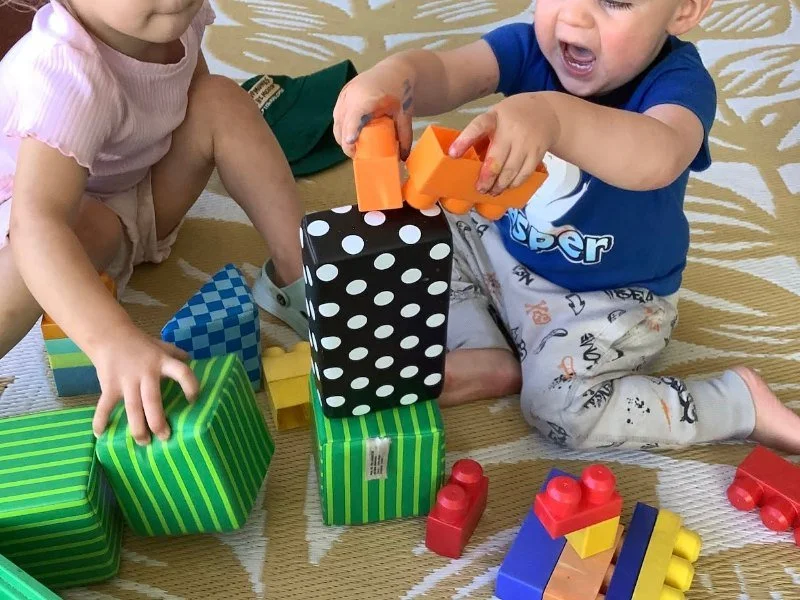
Play is not one thing. Across a week, children move through many types, and each one does a different job.
Pretend play such as shops, families and superheroes builds language, empathy and flexible thinking.
Construction play with blocks, boxes and sand builds spatial reasoning, planning and persistence.
Physical play such as climbing, running and dancing builds strength, balance and body awareness.
Sensory and messy play with water, dough, paint and mud builds fine motor control and early science thinking.
Games with rules such as memory, hide and seek and simple board games build turn taking and self-control.
A well-planned room offers all of these every day, indoors and out, so each child can find a way in.
What Play-Based Learning Looks Like in Practice
Play-based does not mean anything goes. A good program moves between three modes across the day.
Child-led play is when children choose what to do and how. The cafe is a good example. Educators watch closely, because this is where a child's real interests and abilities show.
Guided play is when an educator steps into the game to stretch it. They might ask how much a babycino costs, add a menu and a notepad, or wonder aloud what the cafe could sell if the machine stays broken. The game still belongs to the children. The educator has simply opened a door.
Intentional teaching is when an educator plans a specific experience, such as a science experiment, a group story or a cooking activity, and delivers it in a playful, hands-on way.
At Chipmunks, programs are refreshed every week around what children are currently interested in. If a room is fascinated by diggers on the building site next door, you might find diggers in the sandpit, construction books in the reading corner and a measuring tape at the block area. The interest is the hook. The learning is planned around it.
What Educators Are Doing While Children Play
From the doorway, it can look as if the adults are simply supervising. Look closer and you will see a lot of deliberate work.
Before the children arrive, educators set up the room as a kind of silent invitation: what is on the table, what is at child height, what has been added since yesterday. During play they observe, listen and take notes or photos. They ask open questions, introduce a new word, model how to join a game or stand back because a child is about to solve something on their own. Afterwards they reflect on what they saw and use it to plan the next step.
Those observations are what you read in your child's updates. They are the evidence that the play had a purpose.
Is My Child Ready for School if They Play All Day?
This is the question parents ask most, and it is a fair one. The short answer is that play is how the foundations for school are laid.
A child who can stay with a game, wait for a turn, listen to someone else's idea and bounce back when things go wrong has the skills a classroom depends on. Early literacy and numeracy are woven through play too: recognising a name on a locker, writing a sign for a shop, counting who is at the table, noticing that two short blocks make one long one.
For children in the year before school, a school readiness program adds more structured, teacher-led experiences on top, such as small group work, early writing and following multi-step instructions. Play does not disappear. It becomes the place where those new skills are practised.
Bringing It Home
You do not need special toys or a timetable. A few simple habits make a difference.
Follow their lead for ten minutes a day and let them direct the game.
Offer open-ended things such as boxes, blankets, pegs and containers.
Ask "What could we try?" before you fix a problem for them.
Resist filling every gap. A little boredom is often where a game begins.
Let ordinary jobs be play: sorting washing, measuring flour, washing the car.
Join in as a character, not a director. Order a coffee and see what happens.
Frequently Asked Questions
What is play-based learning in simple terms? It is an approach where children learn through play that is thoughtfully planned and supported by educators, instead of through formal lessons and worksheets.
Is play-based learning structured? Yes. The day has a predictable rhythm of play, meals, rest and group times, and educators plan experiences with clear learning in mind. The structure sits in the planning and the environment more than in desks and timetables.
Will my child learn letters and numbers? Yes. Children meet letters, sounds and numbers through stories, songs, games and real tasks. Because the learning is attached to something they care about, it tends to stick.
Play Is the Work of Childhood
When your child tells you they "just played" today, there is a good chance they also wrote, counted, argued their case and solved a problem or two. Play is not a break from learning in the early years. It is the way learning happens.
To see play-based learning in action, book a tour at your nearest Chipmunks Childcare centre and watch a room for a few minutes. Then ask the educators what they noticed.
